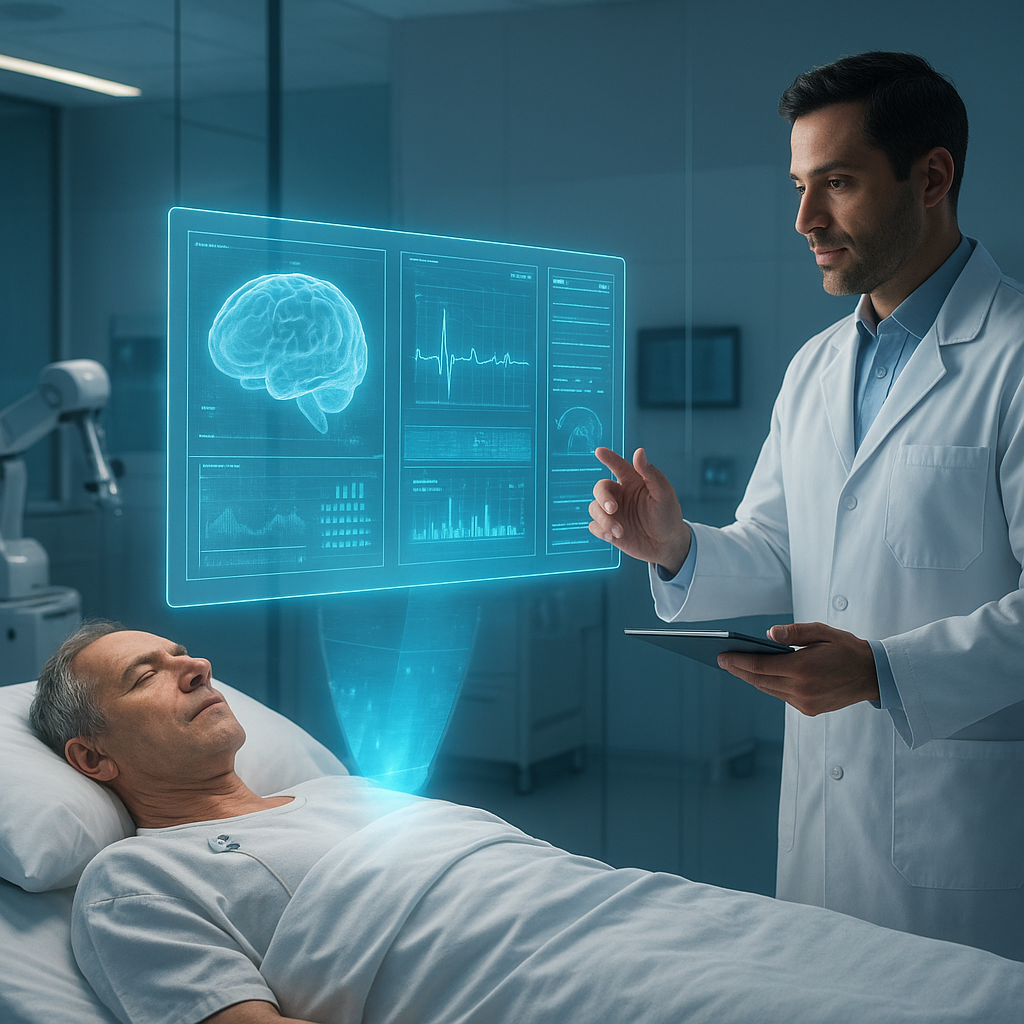
Artificial intelligence has quietly transformed from a niche research curiosity into one of the most consequential forces reshaping modern medicine. From early rule-based diagnostic systems in the 1970s to today’s deep learning algorithms that can detect cancer with remarkable precision, the journey of AI in healthcare is as fascinating as it is significant. Understanding how we arrived at this point — and where things are headed — matters enormously for patients, clinicians, and healthcare systems worldwide.
Where It All Began: The Early History of AI in Medicine
The story of artificial intelligence in healthcare doesn’t begin with smartphones or cloud computing. It begins in university research labs during the 1970s, when computer scientists and physicians first dared to ask whether machines could assist in clinical decision-making.
The MYCIN Era and Expert Systems
The first landmark moment came with MYCIN, developed at Stanford University between 1972 and 1976. MYCIN was an expert system designed to identify bacteria causing severe infections and recommend antibiotics based on a set of if-then rules provided by medical specialists. Remarkably, studies showed it performed comparably to — and sometimes better than — human clinicians in its specific domain.
MYCIN was never actually deployed in clinical practice, largely due to ethical concerns and practical limitations, but it proved something critical: machines could be taught to reason through complex medical problems. This inspired an entire generation of expert systems — AI programmes built on structured knowledge bases encoding the expertise of experienced physicians.
Throughout the 1980s, several expert systems followed, including INTERNIST-1, which attempted to cover a broad range of internal medicine diagnoses. These systems were impressive in their ambition but brittle in practice. They struggled to handle uncertainty, couldn’t learn from new information, and required enormous manual effort to update and maintain. By the early 1990s, enthusiasm for traditional expert systems had cooled considerably.
The Machine Learning Revolution: 1990s to Early 2000s
The limitations of rule-based systems created an opening for a fundamentally different approach — one where machines could learn patterns from data rather than following pre-programmed rules. Machine learning emerged as the dominant paradigm in AI research during the 1990s, bringing with it new possibilities for healthcare applications.
Statistical methods like neural networks, support vector machines, and Bayesian classifiers began appearing in medical research. Early applications included analysing electrocardiograms, interpreting medical images, and predicting patient outcomes based on clinical variables. A 1996 study published in the New England Journal of Medicine demonstrated that a neural network could predict the risk of cardiac events with accuracy comparable to experienced cardiologists — a finding that caused considerable excitement in both fields.
The Rise of Electronic Health Records
A crucial development during this period wasn’t purely about AI itself — it was the gradual adoption of electronic health records (EHRs). As hospitals and clinics moved away from paper-based systems, vast amounts of patient data began accumulating in structured digital form. This shift created the raw material that modern AI systems would eventually need to learn from at scale.
By the mid-2000s, many healthcare institutions in the United States, United Kingdom, and across Europe had invested heavily in EHR infrastructure. The NHS in England, for example, had been developing digital health records as part of its National Programme for IT. These investments would prove foundational for the AI breakthroughs that followed.
The Deep Learning Breakthrough: 2010s
If the history of AI in healthcare has a single transformative decade, it is undoubtedly the 2010s. The convergence of three factors — massive datasets, powerful graphics processing units (GPUs), and advances in deep learning algorithms — created conditions for capabilities that would have seemed extraordinary just years earlier.
Deep learning, a subset of machine learning using multi-layered neural networks inspired loosely by the human brain, proved extraordinarily effective at identifying patterns in complex, high-dimensional data. In healthcare, this translated into remarkable performance on image-based tasks.
AI in Medical Imaging
One of the most celebrated early demonstrations came in 2017, when researchers at Stanford University published a study showing that a deep learning algorithm could diagnose skin cancer from photographs with accuracy matching that of board-certified dermatologists. Around the same time, Google’s DeepMind published research demonstrating that an AI system trained on retinal fundus photographs could detect over 50 eye diseases with expert-level accuracy.
These weren’t isolated examples. By the late 2010s, peer-reviewed research was demonstrating AI performing at or above human expert level in:
- Detecting diabetic retinopathy from retinal scans
- Identifying pneumonia from chest X-rays
- Classifying malignant tumours in mammograms
- Detecting early signs of Alzheimer’s disease in brain MRI scans
- Predicting sepsis in intensive care patients
According to a report by Accenture, the AI health market was valued at approximately $2.1 billion in 2018 and was projected to reach $36.1 billion by 2025 — a trajectory reflecting genuine clinical enthusiasm rather than mere speculation.
AI in Healthcare Today: Real-World Applications
The current landscape of AI in healthcare spans far beyond diagnostic imaging. Today’s applications touch nearly every aspect of clinical practice and health system management.
Drug Discovery and Development
Pharmaceutical companies have increasingly turned to AI to accelerate and reduce the cost of drug discovery, which traditionally takes over a decade and costs billions of pounds. AI platforms can analyse vast chemical libraries, predict how molecular structures will interact with biological targets, and identify promising drug candidates far more quickly than traditional methods.
A landmark example came in 2020 when DeepMind’s AlphaFold solved the protein folding problem — predicting the three-dimensional structure of proteins from their amino acid sequences with extraordinary accuracy. This breakthrough, described by some scientists as one of the most significant in biology in decades, has profound implications for understanding disease mechanisms and designing targeted therapies.
Clinical Decision Support
Modern clinical decision support systems powered by AI are far more sophisticated than their MYCIN-era predecessors. Today’s systems can analyse a patient’s entire medical record, flag potential drug interactions, suggest differential diagnoses, and alert clinicians to deteriorating patients in real time. Epic, one of the largest EHR providers, has integrated numerous AI-based alerts and predictions directly into its clinical workflows.
Natural Language Processing in Healthcare
A significant proportion of medical information exists in unstructured text — clinical notes, discharge summaries, radiology reports. Natural language processing (NLP) technologies have advanced to the point where AI can extract clinically meaningful information from free-text documents, enable voice-to-text clinical documentation, and even summarise complex patient records for time-pressed clinicians.
AI in Mental Health
Mental health represents one of the more surprising frontier areas for healthcare AI. Research has demonstrated that AI systems can detect subtle linguistic and vocal patterns associated with depression, bipolar disorder, and even suicidal ideation. Several mental health chatbot applications have reached millions of users, offering accessible support between clinical appointments. While these tools are not replacements for professional care, they represent an intriguing expansion of AI’s reach into psychological wellbeing.
Challenges and Ethical Considerations
The evolution of AI in healthcare has not been without serious concerns. As these technologies become embedded in clinical practice, understanding their limitations is just as important as celebrating their capabilities.
Bias and Health Inequity
AI systems learn from historical data — and historical medical data reflects historical inequities. Studies have documented bias in AI diagnostic tools that perform less accurately on images from darker-skinned patients, or risk models trained predominantly on data from certain demographic groups. A widely cited 2019 study in Science found that a commercial algorithm used in US hospitals systematically underestimated the healthcare needs of Black patients due to proxy variables embedded in its training data.
Addressing algorithmic bias requires diverse training datasets, rigorous validation across demographic subgroups, and ongoing post-deployment monitoring — challenges that demand sustained attention from developers, regulators, and healthcare institutions alike.
Regulatory and Governance Frameworks
Regulators have been working to keep pace with rapidly evolving AI technologies. In the UK, the Medicines and Healthcare products Regulatory Agency (MHRA) has developed specific guidance on software as a medical device. The US Food and Drug Administration (FDA) has approved over 500 AI-enabled medical devices as of the early 2020s. The European Union’s AI Act, adopted in 2024, classifies most medical AI applications as high-risk, subjecting them to stringent transparency and oversight requirements.
Explainability and Clinician Trust
Many of the most powerful AI models operate as “black boxes” — producing outputs without clear explanations of the reasoning behind them. This creates a significant challenge in clinical settings, where accountability and explainability are not merely desirable but often legally and ethically required. The field of explainable AI (XAI) has emerged specifically to address this problem, developing methods that allow AI systems to articulate why they reached a particular conclusion.
The Future Trajectory of AI in Healthcare
Looking ahead, several emerging developments are likely to shape the next chapter of AI in medicine. Multimodal AI — systems capable of integrating diverse data types including imaging, genomics, clinical notes, and wearable sensor data — promises a more holistic understanding of individual patient health than any single data source could provide.
The rise of federated learning offers a potential solution to the tension between data privacy and AI performance. Rather than centralising patient data in a single location, federated learning allows AI models to train across distributed datasets while keeping sensitive information local — a paradigm with particular relevance for cross-institutional and cross-national healthcare AI collaboration.
Meanwhile, the integration of AI with genomics and precision medicine continues to advance. AI systems capable of interpreting whole-genome sequencing data, identifying disease-associated variants, and predicting individual treatment responses bring the promise of truly personalised medicine meaningfully closer.
Conclusion
The evolution of artificial intelligence in healthcare represents one of the most remarkable technological journeys in modern science. From the rule-based expert systems of the 1970s through the machine learning advances of the 1990s and into today’s deep learning era, AI has progressively demonstrated its potential to augment clinical expertise, improve diagnostic accuracy, accelerate drug discovery, and expand access to healthcare insights.
Yet the story is far from finished — and not without complication. Challenges around algorithmic bias, data governance, explainability, and equitable access remain genuinely pressing. The most important lesson from the 30-year history of AI in medicine may be that technological capability alone is never sufficient. Translating AI potential into real clinical benefit requires careful validation, thoughtful regulation, diverse and representative data, and meaningful collaboration between technologists, clinicians, patients, and policymakers.
As AI tools become increasingly embedded in healthcare systems around the world, understanding their history, their current capabilities, and their genuine limitations is essential for anyone engaged with the future of medicine — whether as a patient, a healthcare professional, or simply a curious observer of one of the most consequential technological shifts of our time.